
BLOG
Acupuncture for Menopause and Perimenopause in Muskoka
Short answer: For many women, yes, though not for every woman. In a US trial of 209 women with frequent hot flashes and night sweats, acupuncture reduced their frequency by an average of 36.7% over six months, and the benefit held for six months after treatment stopped (Menopause, 2016). About half of the women had a substantial reduction, while roughly a third saw little change (Menopause, 2017).
The research is stronger for sleep. A review of 12 trials found acupuncture improved sleep quality in perimenopausal insomnia, including compared with sham acupuncture (Frontiers in Medicine, 2025).
Most women who respond notice a change within the first eight weeks. Treatment is more frequent at the start, then spaced out.
If you already know you'd like to come in, you can book an initial acupuncture appointment in Gravenhurst here.
Key takeaways
In a 209-woman US trial, acupuncture reduced hot flashes and night sweats by an average of 36.7%, and the benefit lasted six months after treatment ended.
About half of women respond well; roughly a third see little change.
The evidence is strongest for sleep, with sham-controlled trials showing more total sleep and fewer night wakings.
Most women who respond notice a change within the first eight weeks of weekly treatment.
Acupuncture can be used alongside hormone therapy, and is an option for women who can't take hormones.
What women bring through the door
It rarely starts with hot flashes. More often it starts with sleep: waking at 3 a.m. for no reason, then lying there wide awake. Cycles shift, shorten or skip. Patience thins. Words go missing mid-sentence.
Then the heat arrives. A flush rises from the chest into the face in the middle of a meeting. Night sweats soak the sheets, and a Muskoka summer night on the dock becomes something to endure.
Many women come to me after being told this is simply part of getting older. Some are on hormone therapy and want more support. Others can't take hormones, or want to understand their options first. All of them want to feel like themselves again.
How Chinese medicine understands menopause
Chinese medicine calls this time the Second Spring. It marks a turning in a woman's life, when the energy that went into monthly cycles for decades gathers back toward the woman herself.
The transition can be bumpy when the body's cooling, anchoring resources are depleted. We describe this as Kidney yin running low. Yin is the cool, moist, settling quality in the body. When there is less of it, heat rises unchecked, which shows up as flushes, night sweats, a dry mouth, restlessness and broken sleep.
Liver qi stagnation often joins the picture. The Liver keeps qi and emotions flowing smoothly. Stress, frustration and feelings held back constrain that flow, and qi that cannot move begins to build heat. That heat rises too, adding to the flushes, along with irritability, a tight chest or jaw, headaches, sighing and tender breasts.
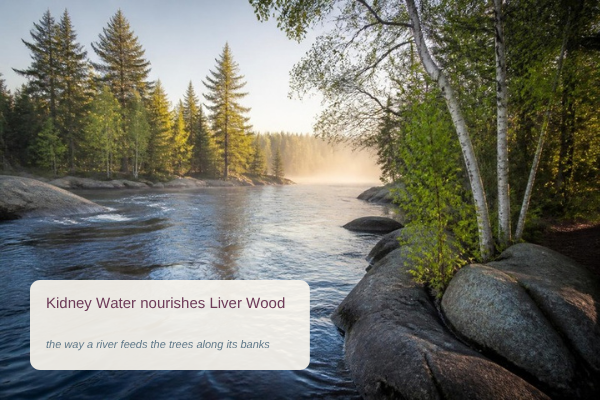
The Liver and Kidneys are closely bound. In the Five Phases, Kidney Water nourishes Liver Wood, the way a river feeds the trees along its banks. When Kidney yin runs low, the Liver loses its nourishment and becomes more easily agitated. Constrained Liver heat then dries the yin further, and the two feed each other in a loop.
This is why emotions matter so much at this stage. Midlife often carries a great deal: work, aging parents, children leaving or not yet gone, and years of putting others first. Treatment helps the Liver move freely while nourishing the Kidneys underneath.
Every woman's pattern is a little different. For one the heat is the main story; for another it is anxiety, palpitations or exhaustion. Treatment follows your pattern, which is why two women with hot flashes may receive quite different treatments.
From a research standpoint, the mechanisms are still being studied. Effects on the nervous system's temperature regulation and on stress physiology are the leading explanations.
The evidence, plainly stated
Here is what the published research reports, including where it is mixed. These are group averages, not predictions about any one woman.
Hot flashes and night sweats
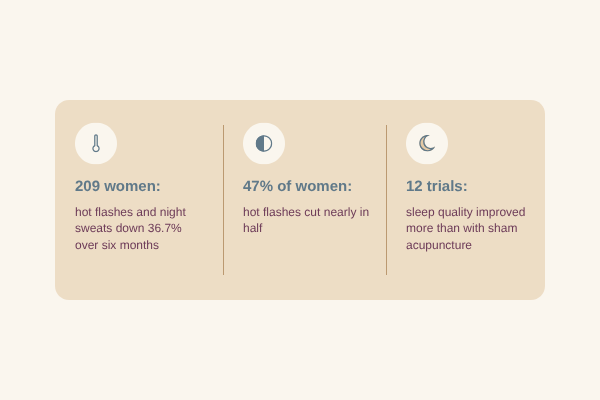
The Acupuncture in Menopause (AIM) study enrolled 209 women aged 45 to 60 who had at least four hot flashes or night sweats a day. Women who received up to 20 acupuncture treatments over six months had an average 36.7% drop in frequency. The waitlist group saw a 6% increase, then a similar 31% drop once they received acupuncture themselves. Benefits held for six months after treatment ended (Menopause, 2016; NCCIH summary).
A follow-up analysis looked at who responded. About 47% of women had their hot flashes cut nearly in half, and about 12% had an 85% reduction. Roughly 37% saw little change. Women who had more treatments in the first eight weeks tended to do better (Menopause, 2017).
Where the evidence is mixed
The AIM study compared acupuncture with no treatment, not with sham needling. Trials that compare real and sham acupuncture for hot flashes have had mixed results. For that reason, The Menopause Society's 2023 position statement concluded the evidence does not yet support traditional acupuncture for hot flashes, and that electroacupuncture needs more rigorous study (Menopause, 2023).
I include this because you deserve the full picture. Acupuncture is one option among several, and it works well alongside medical care.
What I see in clinic
In my own practice, I frequently see hot flashes ease and sleep improve when women come in for regular acupuncture and pair it with dietary and lifestyle shifts. I also see emotions become more stable and less irritability with a widening bandwidth of tolerance. That is my clinical experience rather than trial data, and it reflects acupuncture, food and daily habits working together.
Sleep
The evidence for sleep is more encouraging. In a sham-controlled trial of 84 perimenopausal women with insomnia, acupuncture led to longer total sleep, better sleep efficiency and fewer night wakings than sham acupuncture (Nature and Science of Sleep, 2020). A 2025 review of 12 trials found acupuncture improved sleep quality more than sham acupuncture, though the authors rated the overall evidence low to moderate in quality (Frontiers in Medicine, 2025).
In the AIM study, women receiving acupuncture also reported better sleep, less anxiety and fewer memory complaints. It is not yet clear whether those changes came directly from acupuncture or from having fewer hot flashes (NCCIH summary).
What happens in a session at Cedar Healing Arts
We talk first. I ask about your cycle or when it stopped, when the flushes come and how often, how you sleep, your digestion, mood and energy, and what you are already doing, including any hormone therapy or medications. Then I check your pulses and look at your tongue.
The needles. They are very fine, sterile and single-use, usually placed in the lower legs, feet, hands, ears and belly. Most women feel a brief dull ache or warmth, then very little.
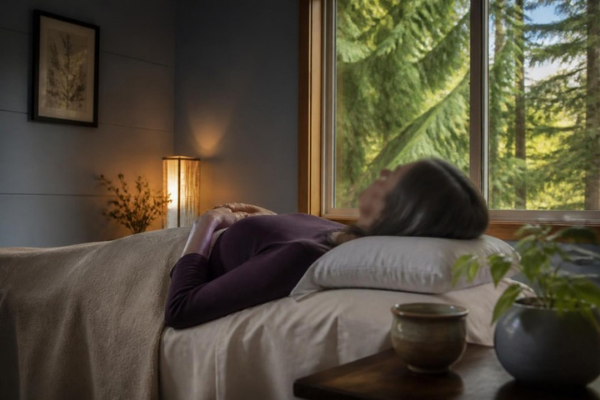
The rest. You lie quietly for 20 to 30 minutes. Many women fall asleep, which for someone who hasn't slept through the night in months can be a treatment in itself.
Depending on what you need, a session may include lifestyle suggestions to support you, dietary guidance for cooling and nourishing foods, and a short qi gong or breathing practice for the moments when the heat rises.
Afterward, most women feel calm and a little heavy. Sleep is often the first thing to change.
Book your first acupuncture session in Gravenhurst
Already a client? Book your follow-up appointment here
How many sessions, and how soon
In the AIM study, women chose their own schedule, up to 20 treatments over six months. Those who had more treatments in the first eight weeks were more likely to respond.
A reasonable plan is weekly sessions for the first six to eight weeks, then every two to four weeks as things settle. Many women then come seasonally, since the turn of each season can stir symptoms up again.
Give it about eight weeks before deciding whether it is working for you. If it isn't, I will tell you so, and we can talk about other options.
When to see your doctor
Acupuncture works well alongside medical care. Please see your doctor about:
any bleeding after your periods have stopped for 12 months
very heavy bleeding, or bleeding between periods
low mood that is deepening, or thoughts of harming yourself
deciding whether hormone therapy is right for you
If you are on hormone therapy or other medication, keep taking it as prescribed. Acupuncture does not interfere with it.
Serving Gravenhurst and all of Muskoka
Cedar Healing Arts is at 193 Maple Heights Drive, Gravenhurst, Ontario P1P 1R1. Treatment is provided by Sonja den Elzen, R.Ac, a Registered Acupuncturist with the College of Traditional Chinese Medicine Practitioners and Acupuncturists of Ontario (CTCMPAO).
Women come to the clinic from across the region:
Gravenhurst: minutes from the town centre
Bracebridge: about 20 minutes on Highway 11 or Muskoka Beach Road
Orillia: about 25 minutes on Highway 11
Huntsville: about 45 minutes on Highway 11
Bala, Port Carling, Muskoka Lakes, Severn Bridge and Washago: about 15 to 25 minutes
Extended health benefits: Acupuncture with a Registered Acupuncturist is covered under many Ontario extended health plans. Receipts are provided for you to submit to your insurer.
Frequently asked questions
Does acupuncture help hot flashes? For many women, yes. In the AIM study, hot flashes and night sweats dropped by an average of 36.7% over six months, and about half of women had a substantial reduction (Menopause, 2016). Trials against sham acupuncture have been mixed, so results vary.
Can acupuncture help menopause insomnia? The research here is encouraging. Sham-controlled trials have found more total sleep and fewer night wakings with real acupuncture (Nature and Science of Sleep, 2020).
Can I have acupuncture while on hormone therapy? Yes. Acupuncture can be used alongside hormone therapy and other medications. Keep taking what your doctor has prescribed.
What if I can't take hormones? Acupuncture is one of several non-hormonal options worth discussing with your doctor. Others with strong evidence include cognitive behavioural therapy and some prescription medications.
Does acupuncture help perimenopause, before my periods stop? Yes, it can. Many of the sleep trials focused on perimenopausal women, and treatment is often helpful while cycles are becoming irregular.
How many sessions will I need? Plan on weekly sessions for six to eight weeks, then spacing out. Women who had more treatments early on were more likely to respond in the AIM study.
Does acupuncture hurt? The needles are far finer than injection needles. Most women feel a brief dull ache or warmth, then very little. Many fall asleep.
Is acupuncture covered by insurance in Ontario? Many extended health plans cover treatment by a Registered Acupuncturist (R.Ac). Check your plan; receipts are provided.
Do I need a doctor's referral? No. You can book directly.
Where is the clinic? Cedar Healing Arts is at 193 Maple Heights Drive, Gravenhurst, serving Gravenhurst, Bracebridge, Huntsville, Orillia, Bala, Port Carling and the wider Muskoka region.
If you are ready to feel like yourself again
You don't need to wait until symptoms are severe, or until you've tried everything else. If sleep, heat or mood have been running your days, that is reason enough to come in.
Book an initial acupuncture appointment
Returning client? Book your follow-up
Cedar Healing Arts · 193 Maple Heights Drive, Gravenhurst, Ontario · Sonja den Elzen, R.Ac (CTCMPAO)
This article is for general information and is not a substitute for individual medical advice. Research findings describe group averages and do not predict individual results. Please speak with your physician about menopause symptoms and treatment options, and do not stop prescribed medication without medical guidance.

Visit Cedar Healing Arts in Gravenhurst
Located in Gravenhurst, Ontario
Cedar Healing Arts offers acupuncture and holistic care in a calm, nature-aligned setting.
We welcome clients from:
• Gravenhurst
• Bracebridge
• Huntsville
• Muskoka Lakes
• Surrounding communities
Appointments available by online booking.
193 Maple Heights Drive, Gravenhurst, ON, P1P 1R1, Canada
(343) 321-1212 for Calls Only
WhatsApp 1-343-321-1212 For Text or Calls
Email: [email protected]
© 2026 CEDAR HEALING ARTS All Rights Reserved
Facebook
Instagram