
BLOG

Acupuncture for Migraines and Headaches in Muskoka
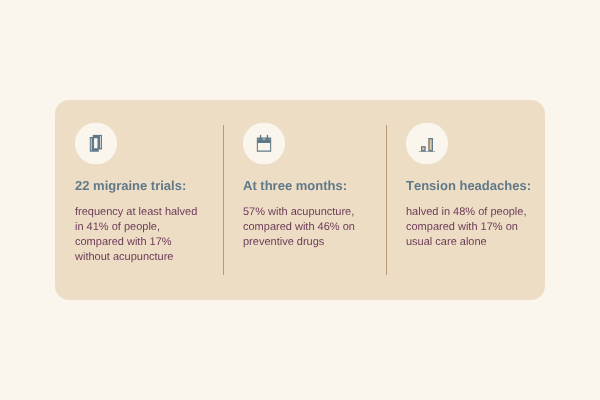
Short answer: Yes. Headache is one of the conditions where acupuncture has its strongest evidence. A Cochrane review of 22 trials and nearly 5,000 people found acupuncture halved migraine frequency in 41% of people, compared with 17% of those without it. After three months it performed at least as well as preventive migraine drugs, with fewer side effects (Cochrane, 2016).
For tension headaches, a second Cochrane review found acupuncture halved headache frequency in 48% of people, compared with 17% receiving usual care alone (Cochrane, 2016). In the UK, the National Institute for Health and Care Excellence (NICE) recommends acupuncture for preventing migraine and chronic tension headache (NICE CG150).
Key takeaways
Acupuncture at least halved migraine frequency in about half of people in sham-controlled trials.
At three months it matched or outperformed preventive migraine medication.
It also helps frequent tension headaches, with benefits still present six months later.
A typical course is about 10 sessions over six to eight weeks, then spaced out.
It can be used alongside your current headache medication.
If you already know you'd like to come in, you can book an initial acupuncture appointment in Gravenhurst here.
What people bring through the door
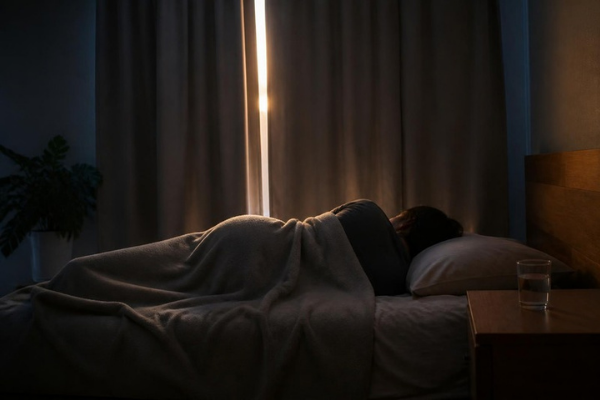
Some people arrive with migraines that have shaped their lives for years. The attack starts with a visual aura or a stiff neck, then comes the throbbing on one side, the nausea, and the dark room with the curtains drawn. A day or two disappears, and then another one the following week.
Others come with a band of pressure around the head that builds through the afternoon. It sits in the temples, behind the eyes, or at the base of the skull, and it tracks closely with screens, deadlines and poor sleep.
Many notice patterns of their own. Headaches arrive before a period, after a stressful week, when the weather turns, or on the first day of a holiday when the body finally lets go.
By the time they come to me, most have a cupboard full of pain relievers and a fear of using them too often. They want fewer headache days, and a sense of what is driving them.
Why this one is personal
In 2010 I was having severe, debilitating migraines five days a week. That sharp, stabbing pain behind the eyes, lasting more than 24 hours, is one of the more intense kinds of pain a person can endure. Strong chemical and scent sensitivities amplified them, along with reactions to certain foods and alcohol. It took time to see what was causing them, because some triggers would not reveal themselves for up to 48 hours.
It all came to a head while I was running my clothing boutique in Toronto. My body was making it clear that something had to change.
That turning point is what brought me into wellness. I began with shiatsu training, the study of Chinese medicine's Five Elements, and macrobiotic living, and slowly learned to read my own patterns and tend them day by day.
Over time, that path brought my migraines from five a week to once a month. I know what it is to plan a life around the next attack, and I know that it can change.
How Chinese medicine understands headaches
Chinese medicine reads a headache by where it sits, how it feels and what sets it off. Each points to a different pattern, so treatment varies from person to person.
Liver yang rising. A throbbing, one-sided headache at the temples or behind the eyes often reflects heat and energy surging upward. Stress, anger and frustration fuel it. This is the classic migraine pattern, and it is often joined by Liver qi stagnation, when tension and held-back feeling keep qi from flowing smoothly. Here acupuncture can do a great deal to smooth the Liver qi.
Blood or Kidney deficiency. A dull, empty ache that is worse with fatigue, after a period, or late in the day points to depletion. The head is simply not being nourished well enough. Here acupuncture, along with nourishing food and herbs, can be supportive.
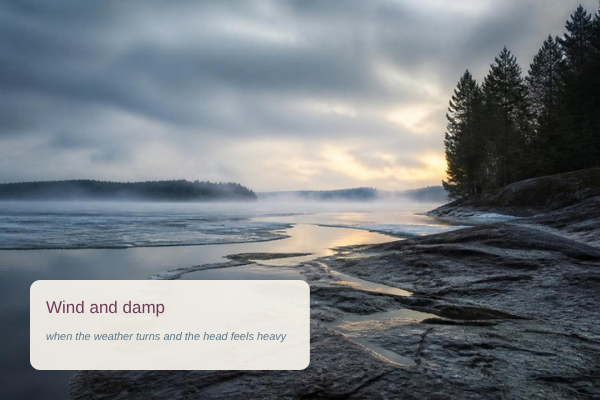
Wind and damp. Headaches that come with a change in weather, or feel heavy and foggy like a band around the head, suggest an outside influence settling in. Anyone who lives through a Muskoka spring thaw knows how the weather can press in. Here we work on clearing the damp: setting aside cold drinks, sugar, dairy and other damp-forming foods, while acupuncture supports the body in clearing it.
Most people show a mix. The Liver and Gallbladder channels run along the sides of the head, the Bladder channel over the top and down the neck, and the Stomach channel across the forehead. Where it hurts guides which channels we work with.
From a research standpoint, acupuncture appears to calm pain signalling in the nervous system and reduce how sensitive the brain becomes before an attack. The mechanisms are still being studied.
The evidence, plainly stated
Here is what the published research reports. These are group averages from studies, not predictions about any one person.
Migraine
A 2016 Cochrane review pooled 22 randomized trials with nearly 5,000 people who had episodic migraine. The results compared acupuncture three ways (Cochrane, 2016):
Versus no acupuncture: migraine frequency at least halved in 41% of people, compared with 17%.
Versus sham acupuncture: 50% compared with 41%, a smaller but real difference that was still present at follow-up.
Versus preventive drugs: after three months, 57% compared with 46%. At six months the two were similar, 59% and 54%.
The reviewers rated the evidence as moderate in quality and concluded acupuncture may be considered for people who want to try it.
Tension-type headache
A second Cochrane review covered 12 trials with 2,349 people. When acupuncture was added to usual care, headache frequency at least halved in 48% of people, compared with 17% receiving usual care alone. Against sham acupuncture the figures were 52% and 43%, and the benefit was still present after six months (Cochrane, 2016).
Guidelines
NICE, which sets clinical guidelines for the UK's National Health Service, recommends a course of acupuncture for preventing chronic tension-type headache, and for migraine when standard preventive drugs are unsuitable or haven't helped (NICE CG150).
Taken together, headache is one of acupuncture's best-supported uses. The gap between real and sham acupuncture is modest, which is why I am honest that results vary from person to person.
What happens in a session at Cedar Healing Arts
We talk first. I ask where the headache sits, how it feels, how often it comes, and what tends to set it off. We also look at sleep, digestion, your cycle if you have one, stress, your diet, your lifestyle and what medication you use and how often. If you keep a headache diary, bring it.
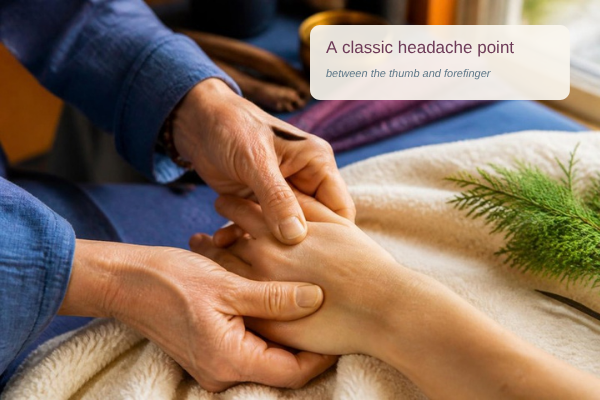
The needles. They are very fine, sterile and single-use. Some go in the neck, shoulders and scalp, and many go in the hands and feet. Points between the thumb and forefinger and on top of the foot are classic headache points.
The rest. You lie quietly for 20 to 30 minutes. Shoulders that have been creeping up toward the ears often drop, and many people fall asleep.
Depending on what you need, a session may include cupping or gua sha across the neck and upper back, which is especially helpful for tension headaches. You leave with a simple acupressure point or two to use at the first sign of a headache, and guidance on sleep, meals and screen breaks.
Afterward, most people feel calm and a little heavy. Drink water and keep the rest of the day gentle if you can.
Book your first acupuncture session in Gravenhurst
Already a client? Book your follow-up appointment here
How many sessions, and how soon
The trials in the Cochrane reviews ran for at least eight weeks, and NICE guidance suggests a course of up to 10 sessions over five to eight weeks. That matches what works well in practice.
A reasonable plan is once or twice a week for the first six to eight weeks, then every three to six weeks as headache days settle. Keeping a simple headache diary helps us both see whether the number and intensity of headaches is changing.
Many people also come in when they feel a migraine building, or during the days before a period if their headaches follow their cycle.
When to see your doctor first
Most headaches are not dangerous, but some need urgent medical attention. Go to emergency for a sudden, severe headache that feels like the worst of your life. See your doctor promptly for:
headache with weakness, numbness, slurred speech or vision loss
headache with fever and a stiff neck
headache after a fall or blow to the head
a new kind of headache, especially after age 50
headaches that are steadily getting worse or changing pattern
If you use pain relievers on more than about 10 to 15 days a month, talk with your doctor too. Frequent use can itself cause more headaches. Acupuncture can support you as you and your doctor cut back.
If you are pregnant or trying to conceive, please tell me, since some headache points are avoided during pregnancy.
Serving Gravenhurst and all of Muskoka
Cedar Healing Arts is at 193 Maple Heights Drive, Gravenhurst, Ontario P1P 1R1. Treatment is provided by Sonja den Elzen, R.Ac, a Registered Acupuncturist with the College of Traditional Chinese Medicine Practitioners and Acupuncturists of Ontario (CTCMPAO).
People come to the clinic from across the region:
Gravenhurst: minutes from the town centre
Bracebridge: about 20 minutes on Highway 11 or Muskoka Beach Road
Orillia: about 25 minutes on Highway 11
Huntsville: about 45 minutes on Highway 11
Bala, Port Carling, Muskoka Lakes, Severn Bridge and Washago: about 15 to 25 minutes
Extended health benefits: Acupuncture with a Registered Acupuncturist is covered under many Ontario extended health plans. Receipts are provided for you to submit to your insurer.
Frequently asked questions
Does acupuncture help migraines? Yes. In a Cochrane review of 22 trials, acupuncture at least halved migraine frequency in about half of people, and after three months it performed at least as well as preventive migraine drugs (Cochrane, 2016).
Does acupuncture help tension headaches? Yes. Added to usual care, it halved headache frequency in 48% of people compared with 17% on usual care alone, with benefits lasting at least six months (Cochrane, 2016).
Is it better than migraine medication? At three months, acupuncture matched or slightly outperformed common preventive drugs, with fewer side effects reported. Many people use both, and you should not stop prescribed medication without talking to your doctor.
Can acupuncture stop a migraine that has already started? It can sometimes ease an attack, but its main strength is prevention: fewer headache days over time.
How many sessions will I need? Most people start once or twice a week for six to eight weeks, about 10 sessions in total, then space out to every three to six weeks.
What about hormonal migraines? Headaches that follow the menstrual cycle are common, and Chinese medicine pays close attention to that pattern. Timing treatment in the days before your period can help.
Does acupuncture hurt? The needles are far finer than injection needles. Most people feel a brief dull ache or warmth, then very little. Many fall asleep.
Is acupuncture covered by insurance in Ontario? Many extended health plans cover treatment by a Registered Acupuncturist (R.Ac). Check your plan; receipts are provided.
Do I need a doctor's referral? No. You can book directly.
Where is the clinic? Cedar Healing Arts is at 193 Maple Heights Drive, Gravenhurst, serving Gravenhurst, Bracebridge, Huntsville, Orillia, Bala, Port Carling and the wider Muskoka region.
If headaches have been taking your days
You don't need to wait for the next bad one. If headaches have been deciding when you work, rest or show up for the people you love, that is reason enough to come in.
Book an initial acupuncture appointment
Returning client? Book your follow-up
Cedar Healing Arts · 193 Maple Heights Drive, Gravenhurst, Ontario · Sonja den Elzen, R.Ac (CTCMPAO)
This article is for general information and is not a substitute for individual medical advice. Research findings describe group averages and do not predict individual results. Please see your physician about any new, severe or changing headache, and do not stop prescribed medication without medical guidance.

Visit Cedar Healing Arts in Gravenhurst
Located in Gravenhurst, Ontario
Cedar Healing Arts offers acupuncture and holistic care in a calm, nature-aligned setting.
We welcome clients from:
• Gravenhurst
• Bracebridge
• Huntsville
• Muskoka Lakes
• Surrounding communities
Appointments available by online booking.
193 Maple Heights Drive, Gravenhurst, ON, P1P 1R1, Canada
(343) 321-1212 for Calls Only
WhatsApp 1-343-321-1212 For Text or Calls
Email: [email protected]
© 2026 CEDAR HEALING ARTS All Rights Reserved
Facebook
Instagram