
BLOG
Acupuncture for Sleep and Insomnia in Muskoka
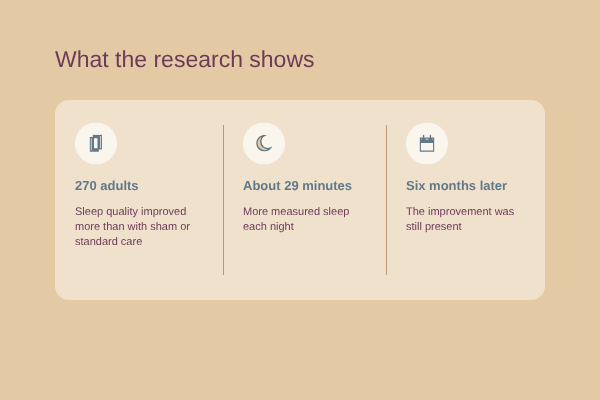
Short answer: Yes, for many people. In a trial of 270 adults with insomnia and depression, eight weeks of electroacupuncture improved sleep quality more than sham acupuncture or standard care alone, added about 29 minutes of measured sleep a night, and the improvement lasted six months after treatment ended (JAMA Network Open, 2022).
In perimenopausal women with insomnia, a sham-controlled trial found longer total sleep and fewer night wakings with real acupuncture (Nature and Science of Sleep, 2020). The research is still developing, and trial quality varies, but sleep is one of the areas where acupuncture shows the most consistent promise.
Key takeaways
Sham-controlled trials show acupuncture can improve sleep quality and total sleep time.
Benefits in the largest trial lasted six months after treatment ended.
Sleep often improves alongside anxiety, low mood and menopausal symptoms.
A typical course is once or twice a week for six to eight weeks.
Acupuncture works well alongside cognitive behavioural therapy for insomnia (CBT-I) and medical care.
If you already know you'd like to come in, you can book an initial acupuncture appointment in Gravenhurst here.
What people bring through the door
Poor sleep takes many shapes. For some, the trouble is falling asleep: the body is exhausted but the mind keeps turning over the day, rehearsing conversations and tomorrow's list.
For others, sleep comes easily and then breaks. They wake at 1 or 3 a.m., wide awake, and lie there until the birds start. Some wake hot and restless. Some wake with a pounding heart for no reason.
Then there is sleep that never feels like rest. Dreams are vivid and busy, and by morning you have the feeling as if the sleep never happened.
Long summer evenings and early light make it hard to wind down, and the short dark days of winter can leave people sleeping a lot but never feeling rested.
Menopause is another time that can bring on a wired-at-night feeling as well.
By the time people come to me for acupuncture, they have usually tried the herbal teas, the melatonin and the sleep apps. They want to sleep through the night again, and to wake up feeling like themselves.
How Chinese medicine understands sleep
In Chinese medicine, sleep is yang sinking into yin, the way the sun drops below the horizon and the lake goes still. During the day our energy moves outward. At night it needs to return inward and rest.
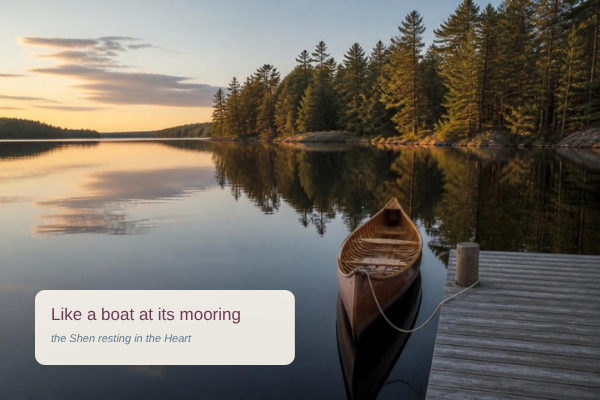
The Heart houses the Shen, the spirit or mind. At night the Shen is meant to settle into the Heart, held there by blood and yin the way a boat rests at its mooring. When that anchor is thin, or when heat or stagnation disturbs it, the Shen wanders, and so do we.
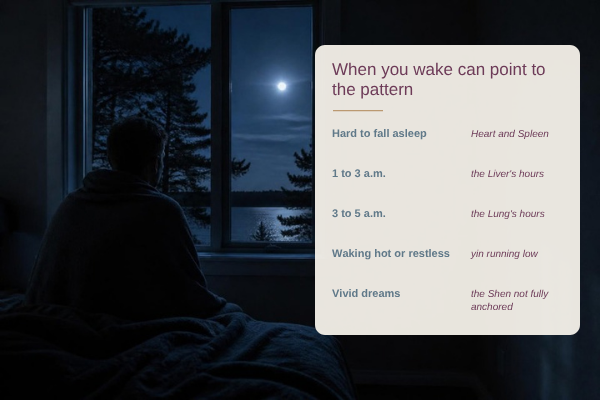
When you wake can point to the pattern behind it. Chinese medicine follows a daily organ clock:
Trouble falling asleep, with a busy, worried mind: often the Heart and Spleen, depleted by overthinking and overwork.
Waking between 1 and 3 a.m.: the Liver's hours, often linked to stress, frustration or held-back feelings.
Waking between 3 and 5 a.m.: the Lung's hours, sometimes tied to grief or sadness.
Waking hot, restless or with a racing heart: often yin running low, so heat rises at night, common in perimenopause.
Vivid dreams and feeling unrested: the Shen not fully anchored.
Treatment is built around your pattern. It nourishes what anchors the Shen, clears heat, and helps stuck energy move, so the body can find its way back to rest.
From a research standpoint, acupuncture appears to calm the stress response and influence the brain chemistry involved in sleep, though the mechanisms are still being studied.
The evidence, plainly stated
Here is what the published research reports. These are group averages from studies, not predictions about any one person.
Insomnia with low mood
A multicentre trial randomized 270 adults with insomnia and depression to electroacupuncture, sham acupuncture, or standard care alone, three times a week for eight weeks. Sleep quality scores improved by 6.2 points with electroacupuncture, compared with 2.5 points with sham and 1.1 points with standard care. Total sleep measured by a wrist device rose by about 29 minutes a night. The improvement was still present 24 weeks after treatment ended, and no serious side effects were reported (JAMA Network Open, 2022).
A review of 21 trials with 1,571 people found acupuncture improved sleep quality more than sham when insomnia came with active depression. It found little added benefit for insomnia that lingered after depression had eased (Frontiers in Psychiatry, 2022).
Insomnia around menopause
In a sham-controlled trial of 84 perimenopausal women with insomnia, acupuncture led to longer total sleep, better sleep efficiency and fewer night wakings (Nature and Science of Sleep, 2020). A 2025 review of 12 trials found similar improvements, though the authors rated the overall evidence low to moderate in quality (Frontiers in Medicine, 2025).
Where acupuncture fits
Medical guidelines recommend cognitive behavioural therapy for insomnia (CBT-I) as the first treatment for chronic insomnia. Acupuncture works well alongside it, and alongside any medication your doctor has prescribed.
Taken together, the research is encouraging, especially when poor sleep comes with stress, low mood or menopause. Many trials are small, so I am honest that results vary from person to person.
What happens in a session at Cedar Healing Arts
We talk first. I ask how you fall asleep, when you wake, what wakes you, and how you feel in the morning. We also talk about stress, digestion, your evenings, screens, caffeine and alcohol, and any sleep medication you use.
The needles. They are very fine, sterile and single-use, often placed in the wrists, lower legs, feet, ears and the top of the head. Points along the inner wrist and behind the ear are classic for settling the Shen.
The rest. You lie quietly for 20 to 30 minutes. For someone who hasn't slept well in months, this is often the deepest rest of the week, and many people drift off.
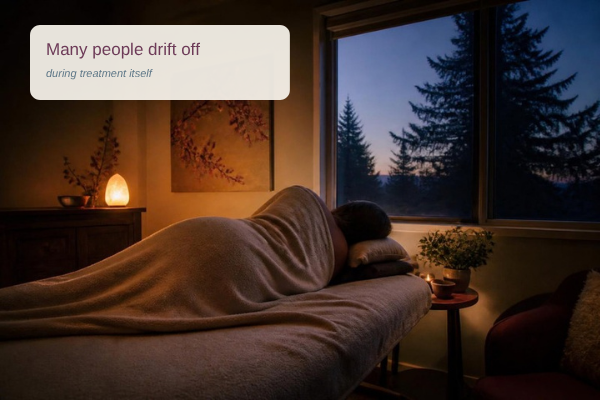
Depending on what you need, a session may include ear seeds you can press at bedtime, a short breathing or qi gong practice to help the evening wind down, and simple guidance on food and daily rhythm.
Afterward, most people feel calm and pleasantly heavy. Many notice they sleep more deeply that first night.
Book your first acupuncture session in Gravenhurst
Already a client? Book your follow-up appointment here
How many sessions, and how soon
In the largest trial, people had three sessions a week for eight weeks. In practice, a reasonable plan is once or twice a week for six to eight weeks, then every two to four weeks as sleep settles.
Some people notice a change after the first few sessions. For long-standing insomnia, give it about six weeks before deciding whether it is helping. A simple sleep diary makes the change easier to see.
Many people then come in seasonally, especially around the long light of summer and the dark of early winter, when sleep is most easily thrown off.
When to see your doctor
Acupuncture works well alongside medical care. Please see your doctor if:
you snore loudly, gasp or stop breathing in your sleep, or feel very sleepy during the day
you have an urge to move your legs at night that keeps you awake
poor sleep comes with low mood that is deepening, or thoughts of harming yourself
you fall asleep while driving or at other unsafe moments
insomnia has lasted three months or more and is affecting your days
If you take sleep medication, keep taking it as prescribed. Talk with your doctor before making changes.
Serving Gravenhurst and all of Muskoka
Cedar Healing Arts is at 193 Maple Heights Drive, Gravenhurst, Ontario P1P 1R1. Treatment is provided by Sonja den Elzen, R.Ac, a Registered Acupuncturist with the College of Traditional Chinese Medicine Practitioners and Acupuncturists of Ontario (CTCMPAO).
People come to the clinic from across the region:
Gravenhurst: minutes from the town centre
Bracebridge: about 20 minutes on Highway 11 or Muskoka Beach Road
Orillia: about 25 minutes on Highway 11
Huntsville: about 45 minutes on Highway 11
Bala, Port Carling, Muskoka Lakes, Severn Bridge and Washago: about 15 to 25 minutes
Extended health benefits: Acupuncture with a Registered Acupuncturist is covered under many Ontario extended health plans. Receipts are provided for you to submit to your insurer.
Related reading: sleep rarely struggles on its own. You may also find Acupuncture for Anxiety and Stress in Muskoka and Acupuncture for Menopause and Perimenopause in Muskoka helpful.
Frequently asked questions
Does acupuncture help insomnia? For many people, yes. In a trial of 270 adults with insomnia and depression, acupuncture improved sleep quality more than sham treatment, added about 29 minutes of sleep a night, and the benefit lasted six months (JAMA Network Open, 2022).
Why do I keep waking at 3 a.m.? In Chinese medicine, waking between 1 and 3 a.m. often relates to the Liver and stress, and waking between 3 and 5 a.m. to the Lungs and grief. Medically, stress hormones and blood sugar can play a part. Treatment looks at your whole pattern.
Can acupuncture help menopause insomnia? Yes, it can. Sham-controlled trials in perimenopausal women found more total sleep and fewer night wakings (Nature and Science of Sleep, 2020).
Can I use acupuncture with sleep medication? Yes. Keep taking any medication as prescribed, and talk to your doctor before making changes.
How quickly will I sleep better? Some people notice a difference after the first few sessions. For long-standing insomnia, allow about six weeks of regular treatment.
Does acupuncture hurt? The needles are far finer than injection needles. Most people feel a brief dull ache or warmth, then very little. Many fall asleep during treatment.
Is acupuncture covered by insurance in Ontario? Many extended health plans cover treatment by a Registered Acupuncturist (R.Ac). Check your plan; receipts are provided.
Do I need a doctor's referral? No. You can book directly.
Where is the clinic? Cedar Healing Arts is at 193 Maple Heights Drive, Gravenhurst, serving Gravenhurst, Bracebridge, Huntsville, Orillia, Bala, Port Carling and the wider Muskoka region.
If the nights have been long
You don't need to wait until you are exhausted to come in. If sleep has been slipping away and taking your days with it, that is reason enough.
Book an initial acupuncture appointment
Returning client? Book your follow-up
Cedar Healing Arts · 193 Maple Heights Drive, Gravenhurst, Ontario · Sonja den Elzen, R.Ac (CTCMPAO)
This article is for general information and is not a substitute for individual medical advice. Research findings describe group averages and do not predict individual results. Please see your physician about ongoing sleep problems, and do not stop prescribed medication without medical guidance.

Visit Cedar Healing Arts in Gravenhurst
Located in Gravenhurst, Ontario
Cedar Healing Arts offers acupuncture and holistic care in a calm, nature-aligned setting.
We welcome clients from:
• Gravenhurst
• Bracebridge
• Huntsville
• Muskoka Lakes
• Surrounding communities
Appointments available by online booking.
193 Maple Heights Drive, Gravenhurst, ON, P1P 1R1, Canada
(343) 321-1212 for Calls Only
WhatsApp 1-343-321-1212 For Text or Calls
Email: [email protected]
© 2026 CEDAR HEALING ARTS All Rights Reserved
Facebook
Instagram